
On this page
The difference
Sectional gutters come in fixed lengths, commonly 10 feet, from a store or supplier. Each length is joined to the next with a connector and sealant. A 40-foot eave has three seams, plus the corners and ends.
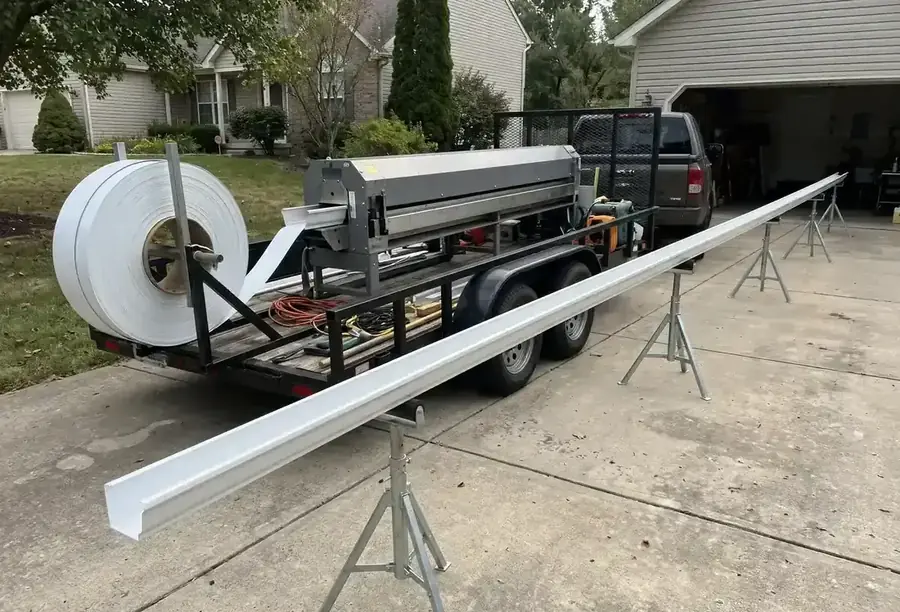
Seamless gutters are formed on site from a roll of coil by a machine on the installer's truck. Each straight run comes out in one piece, cut to the exact length of the eave. The only joints are at the corners, end caps and downspout outlets.
Comparison
| Seamless | Sectional | |
|---|---|---|
| Seams | Corners, ends, outlets only | Every 10 feet plus corners, ends, outlets |
| Leak risk | Low | Higher, rising with age |
| Installation | Contractor with forming machine | DIY or contractor |
| Look | Continuous | Visible seam lines |
| Materials | Aluminum, some steel and copper | Aluminum, steel, vinyl |
| Cost | National guides: about $9 to $13 a foot installed | Lower materials cost; similar labor if professionally hung |
Why seams fail, and why it matters in Seattle
A seam is a joint between two pieces of metal held by sealant and fasteners. Over time:
- Water sits against it. In Seattle, measurable rain falls on about 156 days a year, so a seam is wet for much of the year.
- Debris collects at the seam. Needles and moss catch on the connector, hold water against the sealant and keep it from drying.
- Weight from wet needles and moss flexes the joint.
- Temperature changes make the metal expand and contract, flexing the sealant.
Each seam is a point where these forces concentrate. A sectional gutter with a seam every 10 feet has several of them per run, and they tend to fail one after another as the sealant ages. In a dry climate a failing seam drips in a storm; in Seattle it drips on most days from October to April, onto the same spot of fascia and siding.
When sectional still makes sense
- Short runs and small jobs, such as a shed, porch or garage, where a DIY repair is practical.
- Repairs to existing sectional systems when only one section is damaged.
- Some copper and half-round systems, where sections are soldered rather than sealed.
When to switch to seamless
If your house has old sectional gutters and several seams leak, or the gutters are sagging, rusting or undersized, the time to switch is at replacement. The old gutters come down, the fascia is checked, and new seamless gutters go up in a size chosen for the roof.
A worked example
Here is an illustration. A house in Greenwood has 140 feet of sectional aluminum gutter, with 12 seams plus corners and end caps. Six seams drip, two have been resealed before, and the fascia below one is starting to soften. Resealing all of them would be a modest repair now, but the other seams are the same age and will follow. Replacing with seamless aluminum at the national range of about $9 to $13 a foot costs roughly $1,260 to $1,820 for the gutters and removes all 12 seams at once.
How to tell what you have
Stand under the gutter and look along the bottom. A thin vertical line or a connector every 10 feet or so means sectional. A continuous run from corner to corner means seamless. Drips, stains or green streaks at regular intervals along the siding usually line up with the seams.
Questions to ask about seamless
- What coil thickness will be used?
- How are corners made and sealed: pre-formed or field-mitered?
- What hangers, and at what spacing?
- Are outlets cut and sealed on site?
- Will the old gutters be removed and the fascia checked?
Seamless gutters remove the seams along each run, but corners, ends and outlets are still joints. How well those are made decides how long the system stays leak-free.