
On this page
- What gutter guards do
- Which trees cause the trouble?
- Types of gutter guard
- What do gutter guards cost in Seattle?
- Are gutter guards worth it?
- Guards and Seattle conditions
- What a good guard installation looks like
- Guards and windstorms
- Guards on older and period houses
- Looking after guarded gutters
- Related services
What gutter guards do
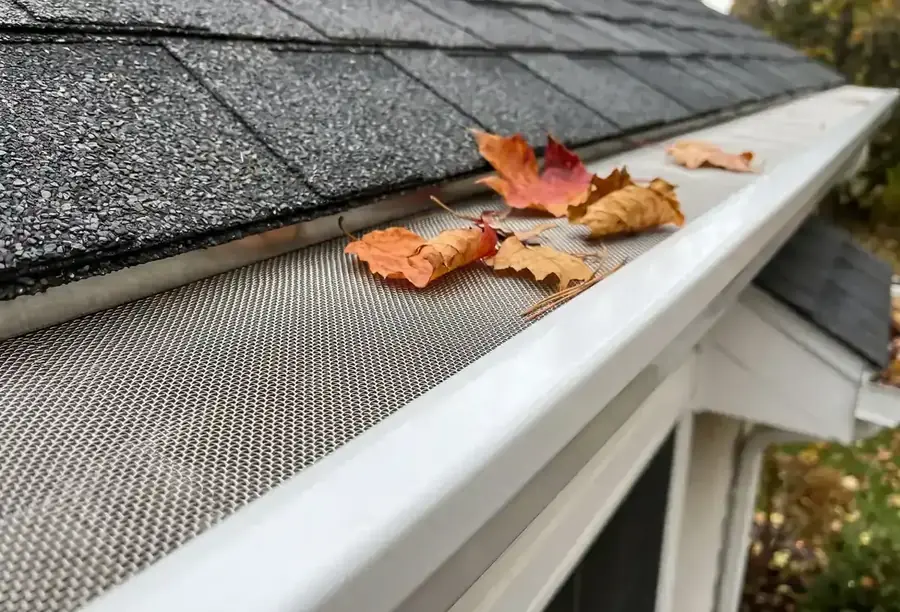
A gutter guard is a cover over the open top of the trough. It lets water in and keeps the bigger debris out, so needles, leaves and moss blow or wash off the roof edge instead of packing into the gutter and the downspout outlet. In Seattle, where rain falls on about 156 days a year, a clogged outlet means overflow day after day, so keeping the outlets open between cleanings is the main point of a guard.
Guards do not make gutters maintenance-free, and they do not fix gutters that are undersized, poorly pitched or loosely hung. They work best on sound, well-hung gutters under trees.
Which trees cause the trouble?
What falls on the roof decides which guard makes sense. Seattle's canopy covered about 28 percent of the city in 2021, and it is a mix of evergreens and broadleaf trees.
| What falls | Common trees | Guard that copes |
|---|---|---|
| Needles | Douglas fir, western red cedar, pines, hemlock | Fine micro-mesh only |
| Large leaves | Big-leaf maple, red alder, cherries | Most guards, including screens |
| Cones and twigs | Firs and pines | Micro-mesh or sturdy screen |
| Seeds and catkins | Maples, alders, birches | Micro-mesh |
| Moss clumps | Shaded roofs | Any rigid guard keeps them out of the trough |
| Shingle grit | Every roof, worse with moss | No guard stops it all; occasional brushing needed |
Types of gutter guard
| Type | How it works | Good for | Watch out for |
|---|---|---|---|
| Micro-mesh | Fine stainless mesh on a rigid frame | Needles, seeds, leaves | Higher cost; fine film can need brushing |
| Screen | Perforated metal or plastic grid | Large leaves only | Needles slip through or lodge in holes |
| Reverse-curve | Water follows a curved nose into a slot | Big leaves under broadleaf trees | Needles collect in the slot; visible from the street |
| Foam and brush inserts | Fill the trough | Short-term fixes | Hold needles and moisture; moss can grow in them |
What do gutter guards cost in Seattle?
National guides give a wide range. HomeAdvisor puts installed guards at about $6 to $13 per linear foot, and Angi reports an average job of about $1,514, with micro-mesh at the higher end. A house with 150 feet of gutter can therefore land anywhere from under $1,000 for basic screens to well over $2,000 for premium micro-mesh. These are national figures, not local quotes.
What moves the price:
- Linear feet of gutter to cover.
- Guard type. Stainless micro-mesh costs more than aluminum screens.
- Height, roof pitch and access. Tall houses and steep lots take longer.
- Gutter condition. Any re-hanging, re-pitching or repairs before the guards go on.
Are gutter guards worth it?
They usually are when you clean gutters more than twice a year, the house is two storeys or more, conifers drop needles over the roof, or you cannot safely use a ladder. They rarely are on a single-storey house under open sky. The are gutter guards worth it guide runs through a simple payback test.
Guards and Seattle conditions
Needles all year. Unlike broadleaf trees, firs and cedars shed needles in every season. A house under conifers fills its gutters slowly but constantly, which is exactly where micro-mesh pays off.
Moss. Oregon State University Extension notes that moss on roofs is inevitable in the moist Pacific Northwest. Clumps that wash off the roof sit on a guard instead of in the outlet, and are easy to brush off. Moss also loosens shingle granules, which can film the top of a fine mesh.
Steady rain. Seattle's rain mostly falls steadily rather than in cloudbursts, which suits mesh guards: water has time to pass through. The heavier days are increasing, though, with 68 days of more than an inch of rain from 2011 to 2020, so a clean guard on a properly sized gutter still matters.
Wind. Windstorms such as the November 2024 bomb cyclone drop branches on roofs. A sturdy metal guard screwed to a well-hung gutter survives far better than a snap-in plastic one.
What a good guard installation looks like
- Gutters are cleaned, checked and re-hung or re-pitched first where needed.
- The guard fits the gutter size exactly and is fastened to the gutter, not just laid in.
- Guards that do not lift shingles are used if your roof warranty requires it.
- Corners and valleys, where water and debris concentrate, are fitted carefully.
- Downspouts are flushed and checked before the job is finished.
Guards and windstorms
Seattle's windstorms, such as the November 2024 bomb cyclone, drop branches on roofs and lift anything that is loosely fixed. Guards that are only laid into the gutter or clipped on can blow off or be knocked loose by falling limbs. Good guards are screwed to the gutter lip and to the fascia or roof edge, and the gutters themselves are re-hung on hidden hangers first. After a big storm, check that guards are still seated and that no branches are resting on them.
Guards on older and period houses
On a bungalow, Tudor or older house where the look of the roof edge matters, low-profile micro-mesh is the least visible option. Reverse-curve covers are seen from the street and change the line of the eave. On half-round and copper gutters, ask for guards made to fit that profile; copper systems need guards and fasteners that will not corrode where they touch.
Looking after guarded gutters
- Check from the ground after the main fall drop and again in spring.
- Brush off any film of needles, pollen or moss on top of mesh guards.
- Flush the downspouts once or twice a year; guards do not stop fine grit from reaching them.
- After a windstorm, look for guards knocked loose by falling branches.
Related services
- Micro-mesh gutter guards
- Screen and reverse-curve guards
- Gutter cleaning before guards go on
- Moss and needle clogs