
On this page
Why Seattle gutters clog
Seattle's gutters clog differently from gutters in drier or more broadleaf cities. Three things combine:
- Needles all year. Douglas firs, western red cedars, pines and hemlocks shed needles in every season. They are small enough to slip into outlets and elbows, and they mat together.
- Moss. Oregon State University Extension notes that in the moist Pacific Northwest, moss on roofs is inevitable. Clumps wash down into the trough, and moss growing on the shingles loosens the granules that protect them, which end up in the gutter as grit.
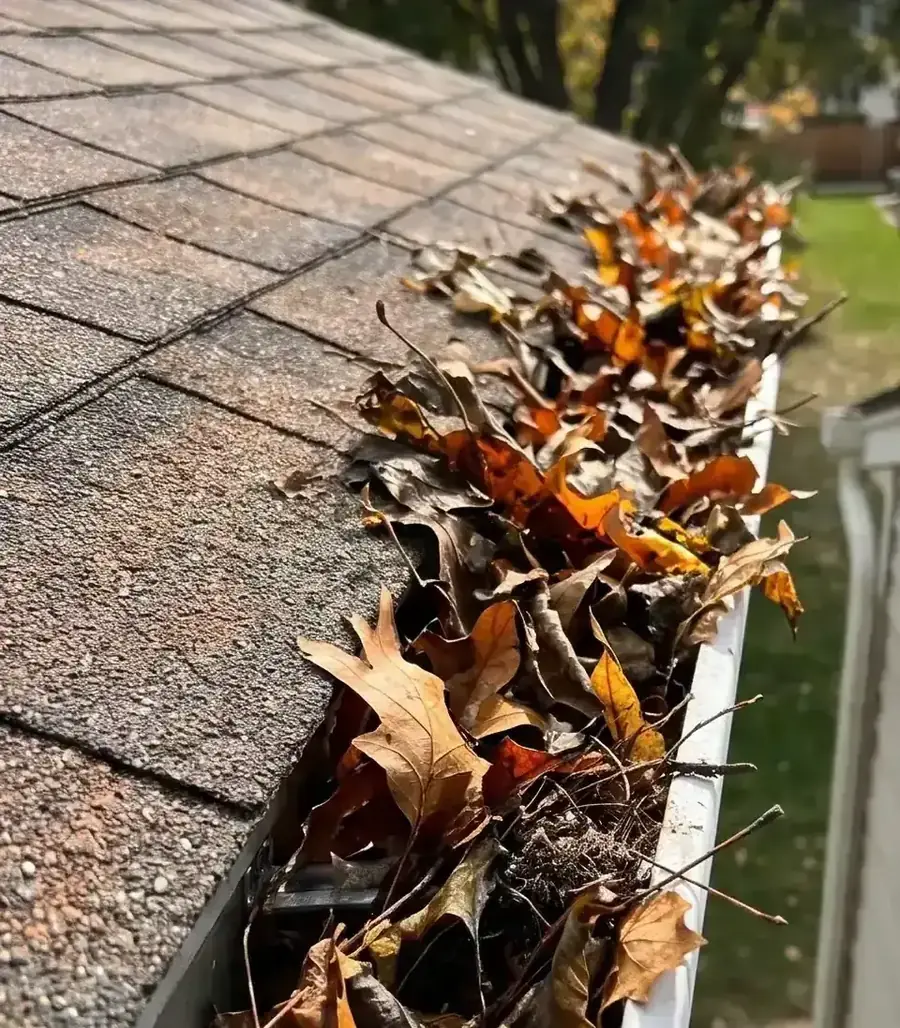
- Constant rain. Measurable rain falls on about 156 days a year. Debris in the gutter rarely dries out; it composts into a wet, heavy mat where grass and seedlings take root.
Seattle's tree canopy covered about 28 percent of the city in 2021, and much of the north end, the lake neighborhoods and West Seattle sit under tall conifers.
What a clog does
| Symptom | What is happening |
|---|---|
| Water spills over the front in light rain | The outlet is plugged |
| Water stands in the gutter days after rain | The outlet or downspout is plugged, or the run has lost its pitch |
| Water pours from a downspout joint | An elbow lower down is plugged |
| Grass or seedlings in the trough | Debris has turned to soil |
| Gutter sagging between hangers | The weight of wet debris is pulling it down |
| Peeling paint on the fascia | Water backs up behind the gutter |
Oregon State University Extension also notes that clogged gutters can back water up to the lowest course of the roof, where it can reach the sheathing.
How a clog is fixed
- Clear the trough and outlets by hand, bagging the debris.
- Flush every downspout from the top; if water backs up, find and clear the plugged elbow.
- Check pitch with a level or string line. A run with low spots will refill with debris.
- Check hangers and fascia where the weight of wet debris has pulled things out of line.
- Recommend the lasting fix: larger outlets, extra downspouts, guards, or a regular cleaning schedule.
Stopping it happening again
- Larger outlets. A 3x4 downspout passes needles that plug a 2x3. Upgrading outlets is often the single most effective change. See 6-inch gutters.
- Micro-mesh guards. Fine stainless mesh keeps needles and moss on top of the gutter, where wind and rain clear most of it. See micro-mesh guards.
- Regular cleaning. Fall, winter and spring under conifers. See how often to clean gutters.
- Deal with roof moss gently. Brush moss off in the direction of the shingles, never pressure wash, and if you use zinc products keep them away from copper: zinc corrodes copper.
- Trim back overhanging branches where it is safe and allowed; OSU notes that trees shading the roof slow its drying between rains.
Cost
Clearing a clog is usually part of a gutter cleaning, which national guides put at about $167 on average. Upgrading outlets, adding downspouts or fitting guards costs more; guards run about $6 to $13 a foot installed. National figures only.
A clog-proofing checklist
- Outlet size. Is it 2x3? Under conifers, a 3x4 outlet and downspout passes far more debris.
- Number of outlets. Long runs with one outlet collect everything at one point. Add a second outlet.
- Guards. Fine micro-mesh keeps needles out; coarse screens do not.
- Roof moss. Brush it off gently so it does not wash into the gutter in clumps. Oregon State University Extension notes moss can loosen shingle granules.
- Branches. Trim limbs that overhang the roof.
- Underground lines. Check that buried downspout lines are not packed with needles.
- Cleaning schedule. Three or four times a year under conifers, until guards are fitted.
When a clog becomes a repair
A clog left through a wet season often becomes a repair. Overflow behind the gutter rots fascia, wet mats pull hangers loose, and seedlings grow roots into seams. If cleaning reveals soft wood or a sagging run, fix those before fitting guards.