
On this page
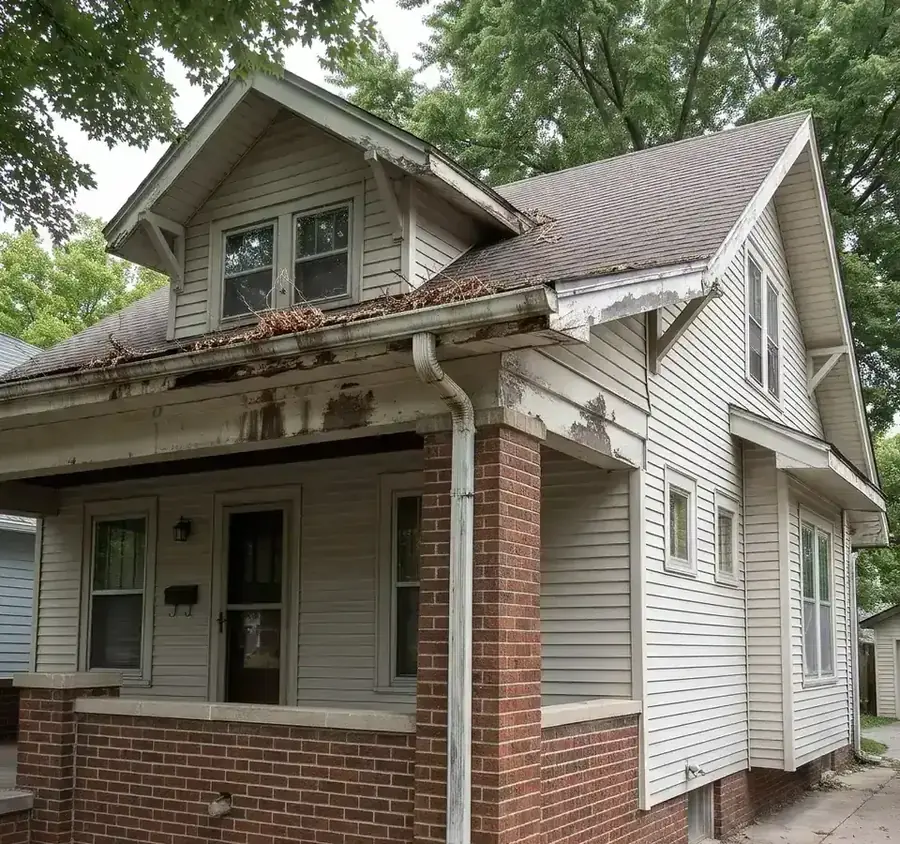
When gutters need replacing, not repairing
Repairs make sense for isolated problems. Replacement makes sense when the problems are everywhere at once:
- Seams leak all along the house. Old sectional gutters have a joint every 10 feet or so, and each one is a future drip.
- Rust or splits. Old steel and galvanized gutters rust from the inside, and thin aluminum splits at corners.
- Several runs sag or pull away. Especially when spikes are backing out of fascia that has gone soft.
- The fascia is rotten along much of the eave. The gutter has to come down anyway to replace the wood.
- They overflow even when clean. The system is too small for the roof, which no amount of cleaning will fix.
- You are replacing the roof. New drip edge and new gutters should go on together.
The repair or replace guide has a fuller checklist.
What a gutter replacement includes
- Removal. Old gutters, downspouts, spikes and hangers come down and are hauled away.
- Wood inspection. With the gutters off, the fascia and the ends of the rafters are checked. Soft or rotten sections are replaced.
- Drip edge. Where it is missing or damaged, drip edge or gutter apron is fitted so water lands in the trough.
- New gutters. Seamless runs are formed on site to the length of each eave, in a size chosen for the roof.
- Hangers and pitch. Hidden hangers are screwed into solid wood at close spacing, with a steady fall to each outlet.
- Downspouts. New downspouts, in larger sizes where needed, discharging away from the foundation and off any slope.
- Test and clean-up. Water is run through each run and downspout, and the yard is cleared.
What does gutter replacement cost?
Replacement is priced like new installation, plus removal and any wood repair. National guides put seamless aluminum at about $9 to $13 a foot installed, with 6-inch about 50 cents to $1 a foot more, steel at about $8 to $13 and copper at about $15 to $40. Removal, haul-away and fascia replacement are usually listed as separate lines. See the Seattle gutter cost guide for a worked example.
Upgrading when you replace
Replacement is the cheapest moment to fix what was wrong with the old system:
| Old problem | Upgrade at replacement |
|---|---|
| Outlets clogging with needles | 6-inch gutters and 3x4 downspouts, and micro-mesh guards |
| Seam leaks | Seamless gutters with joints only at corners |
| Sagging and pulled spikes | Hidden hangers, screwed, at closer spacing |
| Dents from limbs | Heavier aluminum coil |
| Water at the foundation | Longer extensions, splash blocks, or tightlines to an approved outlet |
| Downspouts onto a slope | Rerouted to a safe discharge point, as Seattle's landslide guidance advises |
| Downspouts into the sewer | A rain garden or cistern through RainWise, where eligible |
Older Seattle houses
Much of Seattle's housing is old. Capitol Hill was annexed in 1886, Wallingford filled with 1920s box houses and bungalows, and Montlake was built mainly between 1903 and the early 1930s with Craftsman bungalows and Tudor-style homes. These houses often have exposed rafter tails, deep eaves, fascia painted many times and, on some, original built-in gutters.
Replacement on these houses takes more care. Rafter tails may need rafter brackets rather than a fascia-mounted gutter, and half-round or copper often suits the house better. Houses in Seattle's landmark districts may need approval for visible exterior changes, so check before work begins.
Replacement after wind damage
When a windstorm brings down a big limb, replacement may be the practical answer. Photograph the damage before anything is moved and call your insurer before signing a repair contract. Check the contractor's registration with Washington L&I's Verify a Contractor tool and expect a signed Notice to Customer on any home job of $1,000 or more. See wind and tree damage.
Timing replacement around the weather
Seattle's dry months are short. Sea-Tac averages only about 5 days with measurable rain in July and August, but around 14 in October and 18 in November. Booking replacement for late spring, summer or early fall gives the crew dry days for sealing joints and checking pitch, and gets the new system in before the wet season.
Replacing gutters with a new roof
If a new roof is planned in the next few years, replacing the gutters at the same time is usually the best value. The old gutters often get damaged when the roof is torn off, the roof edge is open so new drip edge can be fitted properly, and the fascia can be inspected and repaired while everything is exposed. Doing both together also means one round of scaffolding or ladder work instead of two.
What to ask before you sign
- What size gutter and downspout is proposed, and why that size for this roof?
- What coil thickness, and what hangers at what spacing?
- How many downspouts, where, and where will each discharge?
- Is removal and haul-away of the old gutters included?
- How is rotten fascia priced if it is found?
- What workmanship warranty is offered?
Washington law requires a signed Notice to Customer before work starts on home jobs of $1,000 or more, and contractors must be registered with L&I; check the registration with the Verify tool.
Related services
- Gutter installation for the full range of materials and sizes
- Fascia and soffit repair for the wood behind the gutter
- Gutter guards to fit at the same time
- Gutter repair if only one part has failed