
On this page
Why choose copper gutters?
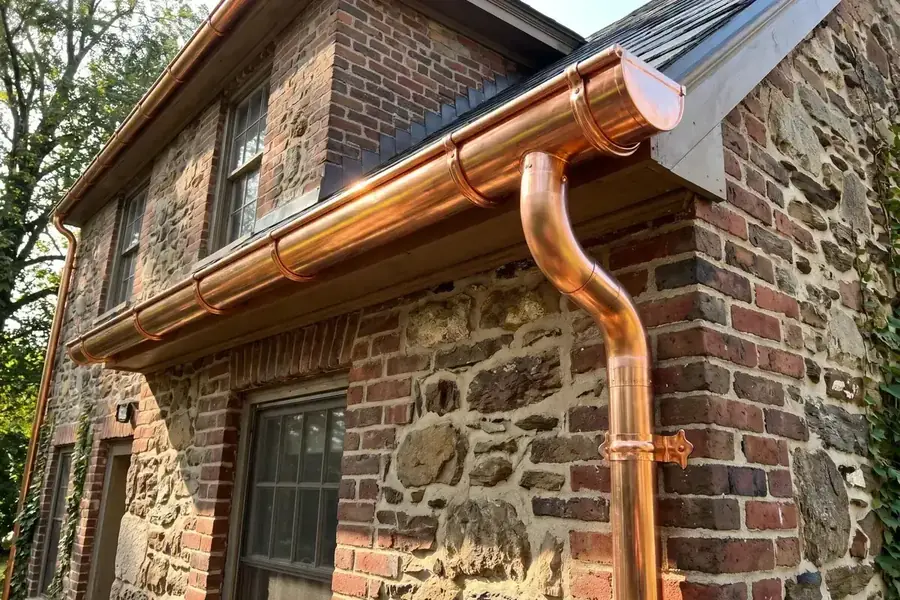
Copper is the premium gutter material. It does not rust, it is strong, its joints are soldered rather than caulked, and it ages to a patina that suits older houses. It costs several times what aluminum does, so it is usually chosen for houses where appearance and longevity matter most.
Where copper suits Seattle houses
Seattle has a deep stock of older houses where copper looks at home:
- Capitol Hill, with mansions and historic homes including "Millionaire's Row" on 14th Avenue East and the Harvard-Belmont Landmark District.
- Montlake, where Craftsman bungalows and Tudor-style homes were built between 1903 and the early 1930s.
- Queen Anne, named for the architectural style many of its early homes were built in.
- Leschi and the other lake neighborhoods, with Craftsman, Tudor and restored bungalows.
- Brick and stone houses across the city, and historic churches.
Copper and moss treatments
This is the single most important thing to know about copper in Seattle. Moss grows readily on shaded roofs here, and many moss treatments use zinc. Oregon State University Extension warns that zinc corrodes copper and that zinc products should not be used where a roof has copper gutters, downspouts or flashing. If you have copper gutters, use a moss treatment that is safe for copper, or remove moss gently by hand, and tell anyone working on your roof.
Copper profiles
| Profile | Look | Notes |
|---|---|---|
| Half-round | Traditional, rounded | Most common for historic copper; hung on round brackets |
| K-style | Flat back, ogee front | Same shape as aluminum, in copper |
| Box or built-in | Hidden in the cornice | Relined in copper on some older buildings |
| Round downspouts | Smooth cylinders | Usual partner for half-round |
| Conductor heads | Decorative collector boxes | Used on churches and grand houses |
What copper costs
National guides put copper gutters at about $15 to $40 a foot installed, against about $9 to $13 for seamless aluminum. The range is wide because copper weight, profile, soldering, brackets and height all vary. A tall house on a steep Queen Anne street with ornate corners and conductor heads sits at the high end.
How copper gutters are installed
- Soldered joints. Corners and seams are soldered, not just sealed, for a joint that lasts as long as the metal.
- Copper or compatible fasteners. Brackets, straps and screws must be copper, brass or stainless. Steel and aluminum corrode against copper.
- Expansion joints. Long runs need expansion joints so the metal can move with temperature.
- Compatible flashing. Drip edge and flashing that the gutter touches must be copper or another compatible metal.
- Round downspouts and conductors. Usually copper too, fastened with copper straps.
Copper and Seattle weather
Copper's strength helps under trees and in windstorms. The Hanukkah Eve windstorm of 2006 and the 2024 bomb cyclone both brought down limbs across the city, and copper on solid brackets holds up better to them than thin aluminum. In Seattle's long wet season, soldered joints that do not depend on sealant are a real advantage. Copper runoff can stain light masonry or paving over time, so downspout placement is worth discussing.
Looking after copper in Seattle
Copper needs less care than other metals, but the Pacific Northwest brings two specific concerns.
Moss treatments. Many roof moss products contain zinc. Oregon State University Extension warns that zinc corrodes copper gutters, downspouts and flashing. If you have copper, remove roof moss by hand or choose a product that is labeled safe for copper, and rinse residue out of the gutters.
Needles and moss in the trough. Copper does not rust, but wet debris sitting against it for months stains it unevenly and keeps soldered joints wet. Regular cleaning, or micro-mesh guards made for copper, keeps the trough clear.
Patina
New copper is bright. Over months it darkens to brown, and over years it can develop a green patina, depending on exposure. In Seattle's damp climate the change is often steady and even. Some owners like the bright look and have it sealed; most let it weather.
Mixing metals
Copper corrodes aluminum and galvanized steel where they touch in water. On a copper installation, flashing, fasteners, brackets and straps must be copper, brass or stainless steel. Water running off copper onto an aluminum gutter below causes the same problem.
Where copper makes sense
Copper suits period and high-end houses where the look matters and the owner plans to stay a long time: Tudor and brick houses, older houses on Capitol Hill and Queen Anne, and larger houses in the lake neighborhoods.