
On this page
Gutter screens
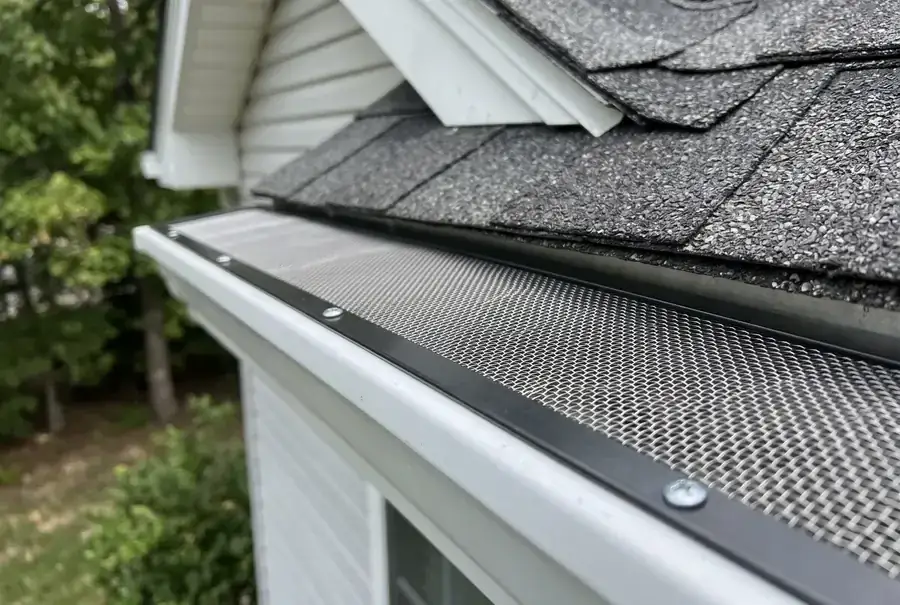
A screen is a grid of holes or slots, in aluminum, steel or plastic, that sits over the gutter. It is the simplest kind of guard. Water and small debris go through the holes; large leaves stay on top and blow or wash off.
Good for: houses with mostly large leaves from big-leaf maples, alders and fruit trees, and owners who want a lower-cost guard.
Less good for: fir, cedar and pine needles, seeds, catkins and grit, which pass through or lodge in the holes. In a wet climate, screens that trap needles become a mat where moss can grow.
Reverse-curve (surface tension) guards
A reverse-curve guard is a solid cover with a rounded nose at the front. Water running off the roof clings to the curve and flows into a narrow slot into the gutter. Leaves, being lighter and drier, slide off the front.
Good for: houses under broadleaf trees with large leaves.
Less good for: conifers, whose needles collect in the slot; shaded, damp roofs where moss and algae grow on the curve; and steep roofs, where fast water can overshoot. Reverse-curve guards are visible from the street, which matters on older houses.
How they compare
| Screen | Reverse-curve | Micro-mesh | |
|---|---|---|---|
| Large leaves | Keeps out | Keeps out | Keeps out |
| Fir and cedar needles | Lets through or lodges | Collect in the slot | Keeps out most |
| Moss clumps | Keeps out large ones | Can grow on the curve | Keeps out of the trough |
| Steady rain | Good | Good when clean | Good when clean |
| Visibility | Low | Visible from street | Low |
| Typical cost | Lower | Moderate to high | Higher |
Seattle considerations
Conifers everywhere. Seattle's canopy, about 28 percent of the city in 2021, includes many tall firs and cedars, especially in the north end, Magnolia, West Seattle and the lake neighborhoods. Under conifers, screens and reverse-curve guards rarely solve the clogging problem.
Damp, shaded roofs. With rain on about 156 days a year, anything that holds needles stays wet, and Oregon State University Extension notes that moss on roofs is inevitable here. Guards that trap debris on top can become a place for moss to grow.
Wind. Windstorms such as the November 2024 bomb cyclone drop branches on roofs. Sturdy metal guards fastened to well-hung gutters survive far better than snap-in plastic.
Guards to avoid
- Foam inserts fill the gutter and hold needles and moisture; moss and seedlings grow in them.
- Brush inserts catch needles and need pulling out to clean.
- Thin plastic snap-in screens warp and crack within a few seasons.
Choosing between them
If the debris is mostly large broadleaf leaves and the budget is tight, a sturdy metal screen is a reasonable choice. If conifers overhang the roof, go straight to micro-mesh. Avoid reverse-curve guards on shaded, mossy roofs and on houses where the look of the roof edge matters.
Cost
National guides put installed gutter guards at about $6 to $13 per linear foot, with an average job of about $1,514. Screens usually sit at the lower end; reverse-curve and micro-mesh at the higher end. National figures only.
Upgrading from screens
Many Seattle houses have older plastic or metal screens that no longer work under conifers. Signs it is time to upgrade:
- Needles matted on top of the screen and inside the gutter beneath it.
- Moss or seedlings growing through the holes.
- Screens warped, cracked or blown out of place.
- Gutters still overflowing despite the screens.
Upgrading usually means removing the old screens, cleaning and re-pitching the gutters, enlarging outlets if needed, and fitting micro-mesh screwed to the gutter lip and fascia.
A worked example
Here is an illustration. A house in Ravenna has snap-in plastic screens under a big-leaf maple and two firs. The maple leaves stay out, but fir needles lodge in the holes and moss grows in the mat. Replacing the screens with micro-mesh, at the national range of about $6 to $13 a foot, stops the needles as well as the leaves.