
On this page
What downspouts do
The gutter collects the water; the downspout delivers it. A good downspout layout puts outlets where the water collects, carries it down the wall without leaking, and discharges it far enough from the house that it does not soak into the soil against the foundation. Most wet basements that people blame on gutters are really downspout problems, and in Seattle, downspouts on slopes are a safety issue as well.
Downspout sizes
| Size | Pairs with | Notes |
|---|---|---|
| 2x3 inch | 5-inch gutters | Standard on many houses; clogs more easily with needles |
| 3x4 inch | 6-inch gutters, or 5-inch with a big roof | Carries far more water, passes needles and moss |
| 3- or 4-inch round | Half-round gutters | Traditional look on older houses |
| 4x5 inch and larger | Commercial roofs | Used on large and flat roofs |
Where the water should go
- Extensions. A section of downspout or a flexible extender carrying water several feet from the wall.
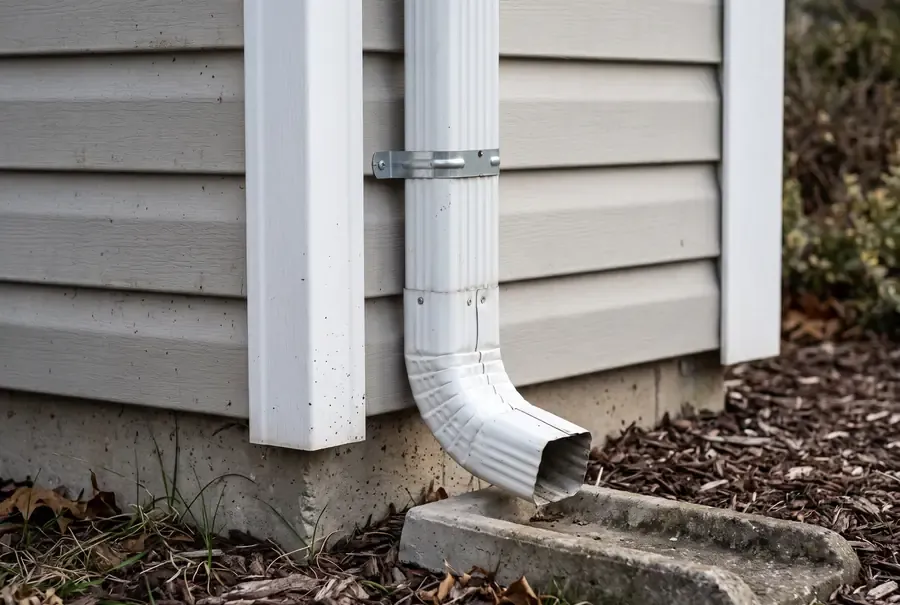
- Splash blocks. Pads that spread the water and stop it digging a hole.
- Tightlines. Solid pipe carrying water to an approved outlet such as a street drain connection or a dispersion area.
- Rain gardens. Planted low areas that soak up roof water away from the foundation.
- Cisterns and rain barrels. Store roof water for garden use; Washington's Department of Ecology explains the state's rules for rainwater collection.
What matters is that the ground slopes away from the house and the water does not end up against your foundation, on a neighbor's property, on a sidewalk or on a slope.
Downspouts on steep lots
About 20,000 Seattle properties, mostly residential, sit in landslide-prone areas, and the city's construction department notes that most landslides are caused by water. Its guidance for property owners on slopes is to keep surface drainage away from vulnerable areas, and to get approval for the discharge point. During landslide season, the department asks owners to check that downspouts are functioning and routed to a safe location.
In practice, that means no splash blocks at the top of a slope, no extensions pointing down a bluff, and no buried lines that end partway down a hill. A contractor can route downspouts into a tightline to an approved outlet. See downspouts on steep slopes.
Downspouts and Seattle's sewers
In some older Seattle neighborhoods, roof downspouts and foundation drains still flow into the sewer; in other areas these connections are not allowed. When heavy rain overloads the combined system, polluted water can overflow into Puget Sound, the Duwamish River and local lakes. The RainWise program, run by Seattle Public Utilities and King County, offers rebates covering most or all of the cost of rain gardens and cisterns on eligible properties, with an average rebate of about $4,740. Disconnecting a downspout means cutting it, capping the drainage line and redirecting the flow, and capping a drainage side sewer that connects to the public system needs a side sewer permit. See RainWise and combined sewers.
Signs your downspouts need work
- Puddles or erosion at the base of a downspout.
- A damp or wet basement wall near a downspout.
- Water pouring out of a joint halfway down the wall.
- A downspout crushed by a mower, car or falling branch.
- Water backing up out of a buried line during long rains.
- Soggy ground or small slumps on a slope below a downspout.
See downspout repair for fixes.
Downspout sizes compared
| Size | Typical use | Needles and moss |
|---|---|---|
| 2x3 inch | 5-inch gutters on small roofs | Plugs easily under conifers |
| 3x4 inch | 6-inch gutters; 5-inch under trees | Passes most needles |
| Round 3 or 4 inch | Half-round systems | Larger sizes pass needles better |
| 4x5 inch and larger | Commercial roofs | Rarely plugs |
Under Seattle's firs and cedars, the opening size often matters more than the gutter. Upsizing to 3x4 is one of the most effective changes on a needle-prone house.
Related pages
- Downspout repair
- Downspout drainage and your foundation
- 6-inch gutters and 3x4 downspouts
- Gutter installation